Today I read a news article. A rather simple article from the Economist about how a patent troll was challenging Apple, a article I would've simply glossed over or skipped 16 weeks ago. But not today, today I sat down and opened the article and read it.
I believe the 2nd greatest benefit this class has given is the ability to converse and understand patent litigation on a macro level. I was able to discern why Apple lost the case, despite their army of lawyers, endless funding, and industry respect. I was able to form a opinion on the issue. And I was able to see the flaw in our PTO system. This ability in my opinion is 10 times as valuable as knowing the process of filing a patent. Imagine if you're speaking with the CEO of a startup, or even a established tech firm of which you hope to work for one day. I would guess he would be much more impressed if you could speak about the patent litigation his company is currently involved with, rather than how he should've filed his patents.
So how can this class help in the future? Short of filing your own patents, I feel the overarching knowledge this class provided is much more useful than it appears at a glance. The collaborative learning, social media, youtube, the list goes on and on. I had never created my own blog, youtube video, or twitter account until this class. Having a class dedicated to learning from my fellow classmates made me realized how much I could really gain from my peers. A lesson I wish I had learned earlier in my college career, but a tip that will be extremely valuable for senior year and beyond.
Berkeley is the number one public university in the world, a flagship institution empowering students to purse the field of entrepreneurship. With programs such as the Skydeck and CET Program, it is no wonder Berkeley is unmatched in its innovative prowess. If you ask any Berkeley student what their plans are for the future, you have a 50/50 shot of hearing the word startup. Yet, if you ask them how they plan to achieve this goal their plans are often no more hashed out than the word patents.
I was one of those students, hoping to work in a groundbreaking field, with absolutely no plan for protecting my work. As we learned in class, this can be disastrous. Patenting is a very opaque convoluted field requiring armies of lawyers to battle over litigations and claims. Even in the most prestigious tech companies like Google, Facebook, and Intel, the patent knowledge is reserved from all but a select few. Looking back at myself, I find it hard to imagine I could've plan to file for a patent given my past knowledge. Looking forward, I still find it hard to imagine I could file a patent given the vast amount of complications and requirements. But knowledge is always better than ignorance.
All and all, I think my greatest takeaway from this class was not the knowledge of how to actually file a patent. But to at least be made aware of the vast amount of knowledge it takes to file a patent, obviously many more years of schooling and experience. My experience with this class has been equivalent to that of Chem 1A or Bio 1A, not enough detail to prepare me to be a chemist, but enough to pique my interest in the field; to help me decide if I want to pursue it further.
In the hopes of improving this awesome and unique class experience for others, I have a few improvements for Professor Lavian's consideration. I'd like to start off with stating each of these are only reflective of my own personal opinions on how I believe the course could be improved.
More guidance and less quantity on comment criteria
I feel the comments were one of the most useful parts of Social Learning, as they forced us to evaluate each blog for points of recognition and critique. However often times such points cannot be summarized in a 4 sentence long quote, and I would've appreciate a lesser number of quotes in order to spend more time quality on each one. Also it would've been helpful if a good quote or bad quote example was given in the beginning of the course, as the GSI continually stressed the important of quality comments without giving us definition of said comment.
Variety of Topics across Youtube and Blog
I really enjoyed both speaking and writing my thoughts about different topics during the course. However I feel writing both a blog AND a Youtube video started to become redundant with many videos simply reading off their blogs as a script. I would recommend instead that both the video and blog post be utilized, but allow for some digression in types of topics to address. I found Youtube videos were much more effective in expressing my personal opinion on topics and my reaction to points made in class, while blog posts were more effective in conveying facts and explaining concepts.
Post Weekly Assignments Earlier
Often times the homework assign would require extensive research, understanding, or internal comprehension which is quite time consuming in its own sense. If the assignments were posted earlier, I feel it would've given the students more time to conduct their research on the topic as well as address the homework while it was still fresh in their heads. Expanding the deadline to Sunday night instead of Friday night would also have the same benefits in my opinion. A regular checkup on students to inform them of any missing assignemtns would have also been most helpful, particulary in my own case.
How do we learn from others? With the rise of technology is has become easier and easier for ideas to be shared and spread, from retweeting, to sharing, to forwarding, to even going viral. This newfound power has arrived with an additional side consequences, we now find it easier and easier to learn from our peers, whether it be through copying and plagiarism, to simple observation. Many professors and classes have failed to fully utilize this untapped potential, and I am quite glad I was able to experience a class that has.
When first instructed to analyze and evaluate my fellow classmates blogs, I initially reacted with apprehension. How was I suppose to gain insight into these blogs and videos when they ha been given the same assignment instructions as me. As the semester progressed I began to realize how much that could be gained from my classmates, noted especially during the to 10 inventions assignment. While the majority of students used the same 20 or so inventions in their top 10 list, I was most intrigued by the students who slipped in advancements that no one else had included. When reading their reasoning and logic behind their decision, I could not help but agree with many of their points and validity, even questioning some of the inventions on my own list.
Overall I think one of the most valuable lessons I learned from this class was not actual course material, but method of learning. Too often we fall into the cycle of believing the only person to be learning from in the classroom is the professor, and I give major credits to Professor Lavian for challenging this assumption. As a famous person once say, "There are obviously two educations. One should teach us how to make a living and the other how to live."
FURTHERING ITS DESIRE to dominate the skies—and our shopping—Amazon has applied for a patent on its somewhat starry-eyed drone delivery system. A
The patent application, originally filed in September 2014 but published last week by the US Patent and Trademark Office, details an elaborate system for “aerial delivery of items.” The drones will talk to each other, receiving information on the delivery environment from other drones to update their routes in real time, determining if their flight paths and proposed landing areas are safe and free of obstacles.
Package delivery locations will be updated as customers move around, so a package can come to you at work or home, depending on where you are when your shipment is ready—including pulling location data from a smartphone. A mockup shows an Amazon order screen with four options for delivery: “Bring It to Me,” “Home,” “Work,” and “My Boat.” There will also be relay locations, allowing drones to drop off packages for further transport, or to recharge or swap batteries. Amazon also wants its drones to be able to drop packages at a “secure delivery location."
Much of the patent application is legalese minutiae, meant to protect Amazon from competitors copying its delivery mechanisms (which could eventually pose problems for other parcel companies like UPS and FedEx). Still, the sheer breadth of the filing shows how much thought Amazon has put into the project—a bit unrealistic as it may be—and some of that thought may be aimed at persuading the FAA to allow drone research and development in the US.
Game publisher King, designer of the widely popular game Candy Crush Saga, has given up on its pursuit to trademark the word "Candy". The issue began when King acquired Candy Crusher in 2009. and made the big to trademark the word "Candy" to protect its flagship game that has helped King dominate the mobile gaming business in 2013. However King does have the word "Candy" trademarking in the European Union, a trademark it wholeheartedly plans on enforcing.
King drew the ire of consumers recently when it began using its trademarks to prevent other developers from selling their games on the iTunes App Store or to file trademarks of their own. Most notably, King filed an official opposition to developer Stoic Studios’ attempts to trademark its epic Viking role-playing game, The Banner Saga. While that story-based PC title has little in common with any of King’s games, the company still filed against it in an effort to protect its many products that feature the word “Saga.”
King is likely trying to get these trademark issues behind it before it debuts its IPO. The company plans to raise $500 million later this year, which would make it the largest publicly held company in the lucrative social-gaming industry. In 2013, the company generated $1.88 billion in revenue and $568 million in profit.
During this post I will be explaining the first to file process explained by Efrat Kasznik in class. Step 1 Research and Development This part is fairly straight forward. The innovating company must invest the resources to create a invention that is non-obvious and novel to qualify for patentable status. This processes often extensive monetary and time costs to the company with little guarantee of success. Step 2 Invention Disclosure
Here is where the first to file and first to declare systems differ. Under the the first to file system, the invention must then be publicized and filed for as a patent to be recognized. Under the first to invent system, this qualification was not necessary as merely maintaining proof of the date of invention was enough to warrant protection.
Step 3 Provisional Application
A provisional application for patent has a pendency lasting 12 months from the date the provisional application is filed. The 12-month pendency period cannot be extended. Therefore, an applicant who files a provisional application must file a corresponding nonprovisional application for patent (nonprovisional application) during the 12-month pendency period of the provisional application in order to benefit from the earlier filing of the provisional application. However, a nonprovisional application that was filed more than 12 months after the filing date of the provisional application, but within 14 months after the filing date of the provisional application, may have the benefit of the provisional application restored by filing a grantable petition (including a statement that the delay in filing the nonprovisional application was unintentional and the required petition fee) to restore the benefit under 37 CFR 1.78.
Step 4 Non-Provisional Application
When filing a nonprovisional utility patent application, it must be submitted in the English language or be accompanied by a translation in the English language, a statement that the translation is accurate, and have payment of the fee set forth in 37 CFR § 1.17(i). If an applicant files a nonprovisional utility application in a language other than English without the translation, statement, or fee, the applicant will be given a notice and time period to submit the missing item(s).
A nonprovisional utility patent application must include a specification, including a description and a claim or claims; drawings, when necessary; an oath or declaration; and the prescribed filing, search, and examination fees.
Step 5 Patent Issued Patent is issued. Let the royalty collection commence.
This blog is in response to the presentation Efrat Kasznik in class regarding strategic patent property.
Efrat's main takeaway during the class presentation was regarding how Intellectual property is a strategic asset to many companies, whether it be copyrights, trademarks, or patents. While I agree wholeheartedly with this, I feel she did not address the counter arguments often made when debating intellectual property law.
During the presentation Mrs. Kasznik stated a interesting fact which I found particularly interesting, there are 250K patents that go into a smartphone. I find it hard to believe there are even 10K different parts that go into a smartphone, design or utility wise. And while it is of course possible I am mistaken, imagine perhaps if I am correct and the number of patents in a phone far outweigh the concepts. Imagine the difficulty our innovators find themselves in, trying to navigate around a field of technology overloaded with patents far beyond its carrying capacity. I personally would find this to be quite a turn-off for both invention and the mobile phone field.
This at last brings me to my counter argument to the patent system. While yes a strong patent system does incentivize innovation, it can also be a deterrent when enforced too heavily. I would characterized this distinction as a strategic advantage, to overbearing suffocation; short term vs long term. A extremely stringent patent system would create short term incentives for the innovators, at the cost of long term advancements when future innovators are unable to navigate a industry, such as the mobile phone industry with 250K patents.
While I am not qualified to speak on the effectiveness of the current patent system, my main takeaway is a cautionary post to not blindly advocate for the strictest patent system possible. Too much of a good thing is too much of a good thing.
Earlier in the semester I did a article explaining how to beat a Patent Troll. Here I want to continue the topic, although in relation to the TED video we just watched. Through this video Drew Curtis talks about his involvement in defeating a patent troll, along with a few key statistics. A few that caught my eye, was the fact it takes an average of 18 months and $2 million to beat a patent troll, assuming you even win. The average blew my mind, and suddenly it became much more clear why so many companies choose to settle instead of debating the lawsuit, regardless if they have infringed.
Another fact that stood out to me is that most startups choose to settle, regardless of whether they have infringed or not. While Mr. Curtis did not specify why they choose to settle, personally I believe it would be from one of two reasons. First and most likely, is the startup is simply too poor to refute the lawsuit in court, and the settlement represents a much cheaper and safer option out. Secondly I think many new companies might have the means of which to fight the lawsuit, but simply be intimidated by the patent troll or misinformed about the exact nature of the infringement.
In the end, regardless of the reason, this highlights a rather disturbing way of which we treat targets of patent trolls. By allowing this exploitive business model to continue, we are forcing our most innovative companies to expend precious resources and time on combating NPE's to defend their well earned inventions, eventually reducing incentives to innovate for future parties.
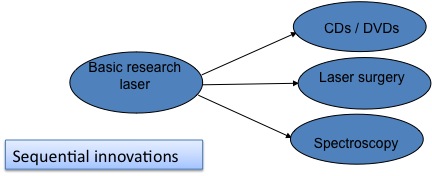
Of all the TED videos we watched during Monday's class, I related to Charles Leadbeater's the most. His stance and perspective on cumulative innovation resonated strongly with another class I am currently taking; Economics of Innovation. Like Leadbeater's video, the class stresses how the majority of innovations in today's world are not singular advancements. Instead they are continual advancements off of previous inventors before them. From what I have learned in the class, this new form of cumulative invention is very difficult to maintain incentive for. Although the first invention is critical to the second, it is difficult to reward both the first and second inventor equally for their contribution, as the 2nd inventor normally retains most of the credit. Usually such problem is remedied through running royalties or forward grants, but they are often very difficult to implement.
The video does accurately describe the problem, much more efficiently than my class I might add. It also calls into a question on how to address the problem in the future. Back paying royalties are still a very viable for of incentive for the initial inventor, as they will be receiving some funds. However they do run the risks that their invention must be useful too some future advancement that will create some economic value. The major downside I see of this system, is that most inventors who are exploring into a new industry will have to be more selective with their research, and acknowledge there is a slight chance of no return on their investment. Overall I don't believe our system has a large of a problem as portrayed in the video, but there is still a problem that needs to be addressed.
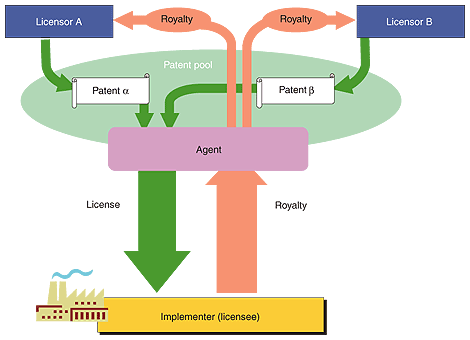
The first ever example of patent pools took place in 1903, when the Wright Brother's developed the very first flying machine. Ecstatic with there success, they immediately patented the invention and persecuted any party that infringed on their turf. There were other parties who maintained interest in the craft of flight however, and the US government eventually interviewed and forced the patent holders to share there patents with the rest of the industry, eventually kicking off the aviation industry that we know today. Without such action by the part of the government, we can never know what might have come of the airplane without the thousands of minds working on it in unions. The flight patent pool is one of most basic textbook examples of patent pools in history.
However there now exists another such example in recent years, one not as beneficial to social welfare. While many people criticized the patent pools regarding airplane manufacturing, there is a undeniable truth of the benefits it provided to society, despite the lost profits to the Wright brothers. Until recently, antiviral drugs used to treat diseases such as HIV cost nearly $12K per person per year, meaning only the most elite and wealthy could afford them. however less developed countries like India did no recognize such patents, and as such began producing their own cheap knockoffs. Eventually the cost fell to almost $350 per person, making the drug available to a much larger population. However in 1995 the Wold Trade Organization instilled a 20 year minimum patent recognition for new medication upon all countries, skyrocketing both the number of patents and cost of drugs.
Personally, I am not sure I am well versed enough in the field to make a judgment call on whether patent pools are good or bad. While the use of patent pools do help expand a industry and speed up the advancement of technological inventions, they do result in a loss of incentives and rewards for the inventor.
*For the organizations sake, I have compiled all 4 silly patent videos and blog posts into one video and post. The majority of this post is focused on the obviousness and economic value related to this patents. Beerbrella Published in 2003 the Beerbrella is a removable attachment to a beverage container in order to shade the beverage from the direct rays of the sun. The apparatus comprises of a small umbrella, 5-7 inches in diameter but variable sizes are allowed. Advertisements and logos may be applied to the umbrella surface for promotional purposes. The umbrella is then to be attached to the beverage container by any means necessary, whether clip, strap, phone, insulator, coaster, or tape. The shaft of the umbrella may also be equipped with a joint to allow the umbrella to be pivoted away from the drinker.
Gerbil Shirt
Approved in 1999, this invention is "a pet display vest for a person, having an elongated, enclosed, pet receiving, passageway extending there across with at least one closable pet admitting entry, at least part of the passageway being transparent so that, when the vest is worn, a pet moving along the passageway across a wearer's body can be viewed by a spectator."
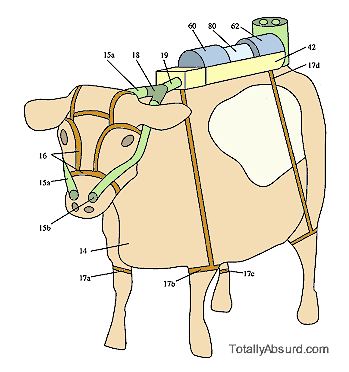
Gas Factory Twenty percent of all methane gas emissions come from domesticated animals, most notable farm animals. However methane is also a very potent energy source, powering gas stoves and heaters in numerous households. One creative inventor saw profit where others saw only smoke, and developed a gas factory invention; a device to be strapped to methane producing animals. The device would then capture the released methane and convert it into biomass, which could then be used as feed or cosmetics. If you notice in the diagram, the device is actually attached to the cows nostrils, instead of rear end. 95% of methane emissions actually come from exhalation instead of inhalation, which is why the majority of the device is focused on the animals front end.
Lightbulb Changer
The light bulb changer is a method and apparatus that contains components to allow for the detection and removal of a burned out light bulb, as well as automatically replacing said light with a replacement bulb. The operation requires no human invention, and can be assembled with minimal extravagant hardware requirements. The kit can allow a consumer to assemble the changer for use as a novelty item, and/or also to be used as a working light fixture, such as a table lamp, and the like. The changer can also be used as a retrofit for existing light fixtures so that the existing light fixtures can be modified.
The majority of international intellectual property disputes regarding Korean companies also involved non-practicing entities, (NPEs). According to the Korean Intellectual Property Protection nAssociation, there were 300 disputes last year, with lawsuits involving NPE's accounting for 81% of them, which was a decrease of 12% from the previous year.
A total of 114 of the suits against NPEs were in the information and communications sector, followed by electrical and electronics (84) and equipment manufacturing (30). By field of technology, computers and mobile represented 31 percent and 21 percent of the cases, respectively. They were followed by AV (13 percent), basic communications processes (11 percent), semiconductors (5 percent), and control (5 percent). In the meantime, the total number of industrial disputes decreased 19 percent from a year earlier to 7,585 last year, and the number of those involved with NPEs dropped 35 percent to 2,856. The ratio of the latter to the former fell from 47 percent to 38 percent between 2013 and 2014, too.
While the Korean government is looking to instill regulations monitoring NPEs, any substantial progress has yet to be made.
When targeted by a patent troll, companies normally are faced with one of two options. The first being succumbing to the NPE's demands and paying a hefty fine or royalty. This is the more frequently seen course of action. The second option is for the company to bring the patent litigation issue to court, a extremely costly and time consuming act that deters most firms. But not Chris Hulls, founder and CEO of the company Life360 who successfully fought and won against a patent troll. He attributes his success to 4 key steps.
"Go Nuclear"
Patent trolls hate being accused publicly. 90% of the threat a patent troll poses is in the initial intimidation of their accusation. The majority of the time firms simply bow down to their demands. Mr. Hulls however directly combated the patent troll head on, publicizing AGIS. Inc, the patent troll's law firm, to both the media and industry, negating much of the patent trolls intimidation presence.
"Share Information and Resources"
Life360 was not alone in their battle against AGIS. Inc. Crowdsourcing all of the information from the tech community, Life360 announced free legal support for another tech startups with less than $25 million in funding who had also been targeted by AGIS. This initiative solved two purposes. First, it drew even more attention to AGIS's cases and the meritless claim against Life360. Secondly, it sent a strong message to both the startup and NPE industry, that Life 360 will not only stand up for itself, but for others as well.
"Go with your gut and commit to it"
As a entrepreneur, or a CEO of a fledgling startup, it can often be hard to justify a combative course of action. But in the end, you always have to remember you are fighting the good fight. "There were some advisors who encouraged me to settle, so I wouldn't have this costly distraction," but Chris Hulls ignore his advisors and took AGIS head on, eventually winning the settlement. You are far less likely to become a target if you have a prior record of victory against patent trolls. Keep victory in site, know what you are fighting for, and give it 100%.
What is a NPE? A NPE stands for Non-practicing entity, or more commonly known as patent trolls. NPE's are a highly controversial topic, both in their practice and their contribution to society. NPE's are defined as entities that earn or plan to earn a majority of their revenue from licensing or enforcement of its patents. As you can imagine, this business model has had serious implications on companies who's products rely heavily on innovation, both from themselves and 3rd parties. As NPE's do not sell products themselves, they are immune to counter-assertion from whichever company they accuse, one of the main settlers in patent disputes. For a company, a lawsuit from a NPE can be extremely costly and stressful, where they must decide between either succumbing to the NPE's allegations and fines, are engaging in a long costly legal dispute.
NPE's can take many different forms. Some companies are choose to license their patents to others with more knowledge and resources to better monetize their advancements. Others instead prefer to sell the patent outright, and avoid the legal hassle of royalties. Many NPE's are given a bad reputation due to the all publicity regarding patent trolls. However many NPE's are engaged in very legitimate business; companies who are unable to capitalize on their research and prefer to sell it. This is a important factor to keep in mind when evaluating NPE's in the workforce.
Just recently top lawyer, Mark Griffin, testified in front of lawmakers that companies spend millions to scare away patent trolls. Others who cannot afford such deterrents are forced to settle, both of which are unnecessary taxes on innocent operating companies. He was joined by CEOs of a credit union and app company, who also related horror stories of patent-based face-offs. The focus of the hearing was to encourage Congress to address the serious issue of patent trolls, who have plagued US companies for years despite numerous attempts by the courts and lawmakers.
Researchers in Hamburg have developed a world changing invention, walls that pee back. Nightclubs have recently began coating the nightclub walls with hydrophobic paint, that causes urine to bounce back on the unsuspecting leaker. The invention was originally designed by Nissan to protect their cars from mud and dirt, but was later found to be just as effective against human fluids. While the costs of the invention run about $700 to cover just six square feet, public urination has long since been a problem in Germany with much public outcry for a solution.
What is Obviousness:
The article I chose to evaluate was from a patent innovation sight called IpWatchDogs. The term of obviousness was set forth by the United States Supreme Court 50 years ago in the Graham v. John Deere case, which solidified non-obviousness as a key factor in determining patentability. Prior to the Graham v. John Deere case the benchmark had been the KSR v. Teleflex case, which defined obviousness as the existence of two previous inventions that would constitute the innovation. The courts to that point also employed a teaching, suggesting or motivation test to determine obviousness If the invention did not teach, suggest, or motivate, it was a obvious invention. The test was eventually thrown out for being too restrictive.
Now there exist 6 rationale a court can reject a patent basis on:
The other rationales available to the examiner are:
If the invention a product of combining prior art elements according to known methods to yield predictable results the invention is obvious.
If the invention is created through a substitution of one known element for another to obtain predictable results the invention is obvious.
If the invention is achieved by using a known technique to improve a similar device in the same way the invention is obvious.
If the invention is created by applying a known improvement technique in a way that would yield predictable results the invention is obvious.
If the invention is achieved from choosing a finite number of identifiable, predictable solutions that have a reasonable expectation to succeed the invention is obvious.
If known work in one filed of endeavor prompts variations based on design incentives or market forces and the variations are predictable to one of skill in the art the invention is obvious.
These are the laws and rules that constituted the definition of obviousness before its culmination into what we have today.
For the purpose of this blog, I evaluated this video clip
According to the video, for a invention to be patentable it must be both novel, and non-obvious. "Non-obvious means whatever is different about your invention, can't be an obvious leap." The patent invention must contain a unexpectedness that would not be obvious to someone in the field. In layman terms, it cannot be an invention in which someone in the field is able to identify and do, but just haven't done it yet. One way to distinguish a difference is to compare the invention to its closest competitors in the field. However this difference can often be highly subjective and is best left to those who work in the patent offices.
Anticipation and Obviousness of Patent: Beverage cup sleeving system and method
(US 20080078824 A1) and Thermal coffee cup (US 2661889 A)
Anticipation: Beverage cup sleeving system
According to the Legal Information Institute "In patent law, anticipation refers to the prior invention or disclosure of the claimed invention by another, or the inventor's own disclosure of the claimed invention by publication, sale, or offer to sell prior to the inventor's application for a patent. [Essentially], if someone else has known about or used the invention before the patent applicant applies for a patent, that patent applicant will not be entitled to a patent." From my personal perspective, I believe the beverage club sleeving system lacks anticipation and should therefore be invalidated as a patent.
From what we have observed with the numerous patents we evaluated, we can see this particular patent includes many of the same claims as its predecessors: a conical layer of insulation, open top and bottom, exterior and interior surface etc. However none of these claims vary in any meaningful way from the patents before it. In anticipation sense, a variant of this patent has already been known and used by consumers. Therefore it is my opinion this invention should not qualify as its own unique patent.
Obviousness: Thermal coffee cup
"A patent for a claimed invention may not be obtained... if the differences between the claimed invention and the prior art are such that the claimed invention as a whole would have been obvious before the effective filing date of the claimed invention to a person having ordinary skill in the art to which the claimed invention pertains." In layman terms, a patent can not be an advancement so minimal that a reasonable person could have created it. This criteria has been utilized many times in the past for numerous petty patent applications, such as the New York man who attempted to patent the stick.
In terms of the patent regarding the thermal coffee cup (filed in 1948) I believed this application does fulfill the criteria of obviousness. One obvious sign of this is the fact the patent application only includes one paragraph of claim, displaying a lack of necessity to specify numerous details to separate itself from earlier inventions. The claim itself is rather broad, specifying the container properties, shape, and texture nuances. Based on the broadness of the claim and lack of similar products in the market at the time, I would quality this patent as being non-obvious.
In this post I provide my own personal insight on the anticipation and obviousness of the beverage sleeve patent list.
To recap, for a patent to be approved, it must be deemed non-obvious. Obvious as a term means the patent must not be obviously related to previous inventions before it, and must show a significant improvement to be patentable as a separate invention. In my personal opinion, very few of these show significant improvement to warrant its own patent and I will explain one. Apart from the thermal coffee cup which I believe is unique enough to warrant its own patent, all of the patents regarding sleeves have the same functionality and structure.
From the initial patent in 2001 to the most recent in 2010, you find the majority of claims are similar and unchanged across the years; specification of a conical shape, flexibility of the sleeve, top and bottom hole for the coffee cup, insulator properties. From my own observation, the only major difference I could discern over the years was the change from paper material to silicon like substitute, to improve reuse and washability, and the change to a clear sleeve as opposed to solid. Are these two factors non-obvious enough to warrant their own patent?
I will first address the change in material. While newly discovered alloys and chemicals are patentable, they are so because they were previously a undiscovered compound that was discovered after years of painstaking research. However once patented, very rarely are they allowed to be repatented for a specific use. There is no such patent to use copper in electric wires as well as pennies in US currency. The same logic can be applied here. Simply because a already discovered material, is used in a already patented invention, does not make it a completely new invention in my opinion while the fundamental use of the product has not changed. I would disagree.
Issued Patents Here I chose to evaluate 3 patents which I believe stood out to me the most and were least redundant.
Insulating sleeve
US 6343735 B1
Filed in 2000 and approved in 2002, this patent regards to a invention known as the insulating sleeve. Previously coffee had been served in insulated cups such as styrofoam which provided excellent insulating in separating heat from the wearer's hands. however as such plastic cups have fallen out of favor due to environmental reasons, a new invention was required to protect drinker's hands. Enter the insulating sleeve. The sleeve in question is, as stated by the claims, an insulating container holder for a container having a sidewall," which is flexible and adaptable to the shape of the cup while still maintain insulation.
Thermal coffee cup
US 2661889 A
One of the oldest inventions on the list, this invention took 5 years to be approved from 1948 to 1953. Unlike the previous coffee cups of the era, this one is unique in the fact that a portion of the cap is able to be torn away, allowing both heat and liquid to escape. However the majority of the cap is to remain on, allowing for the retention of heat. This patent was relatively simple, with only one major claim.
Insulator sleeve for a beverage container
US 7922031 B1
The latest approved patent on the list, the insulator sleeve was filed in 2006 and approved only a year later. With the increase in popularity of numerous coffee chains such as Seattle's Best, Starbucks, and Peets, the number of coffee cups disposed of has increased dramatically, along with their disposable sleeves. This invention aims to reduce the amount of waste created by disposable sleeves. Unlike the patents before it, this claim specifies the sleeve is to be made of, clear material durable material (possibly silicon), allowing for wash and reuse along with the ability to read print underneath the sleeve.
To my understanding, claim one is describing the means of unlocking a handheld device that Apple is patenting. The claim involves the unlocking process as being instigated on a touch sensitive surface by a predetermined image pattern. The unlocking image must be created with continuous contact on the display case and moving from one predetermined location to another; one cannot deviate from the predetermined path or end or start in a non-predetermined location for the locking process to take place.
Samsung vs Apple Patent Litigation Suit
The dispute began when Apple claimed that Samsung allegedly infringed on numerous Apple patents, including the slide to touch unlock mechanism. Samsung counter sued, saying Apple copied off of its own slide to unlock mechanism, and the claim was taken to court. The dispute has spanned multiple countries and involves billions of dollars. Recently a German court ruled that the slide to unlock mechanism was not enough of a technological advancement to even constitute a patent, and Apples claim was thrown out. While the trial is ongoing, so far Apple is winning in the US marketing, where Samsung has been ordered to pay Apple nearly $1 billion in damages. However abroad Apple has received almost nothing, foreshadowing a disturbing trend in the expansion of the Iphone an Ipad. The suit has major implications for both players, and the industry, as Apple gets two thirds of its sales from the Iphone and Ipad, and Samsung is the world's leading supplier of smartphones.
From 1840: Alexis de Tocqueville predicted the Cold War
Amazing display of understanding of macro human sociology and evolution between two superpowers. At a time when world superpowers were not yet known and neither world war had yet taken place, predicting conflict on such a large scale magnitude represents either a large degree of insight, or a very pessimistic outlook on human evolution.
From 1863: When only 60 elements were known, a Russian chemist designed a periodic table that predicted the weights and properties of the missing 40+ perfectly
The ability to recognize past patterns, and predict future results is a undervalued talent in the technology field. Many past technological advances follow a certain trend in core concepts, and being able to recognize future opportunities provides a strong competitive advantage. Failure to do so falls along the lines of the commonly said advice; "those who don't know history, are doomed to repeat it."
From 1987: Roger Ebert predicted video-on-demand services Netflix and Hulu
At a time when television, entertainment, and internet capabilities were still in their infancy, the ability for Robert Ebert to combine all 3 and predict the video-streaming industry shows a remarkable understanding of all 3 functions unique combined potential. Just as it is important to recognize past patterns, recognizing future potential is equally important for innovation.
From 2006: The President of Euro Pacific Capital predicted the housing market crash
Foreseeing future opportunities is invaluable, just as is seeing future risks. At a time when every major bank in America was oblivious to the bubble their were creating, it is reassuring to know not all credit institutions remained blind to the growing problem. Euro Pacific Capital's foresight ability is a likely factor in their survival through the credit crash.
From the 1660s: One day humans would transplant organs from one body to another
In a time when human organs and their functions were hardly known, this prediction takes place as my number one simply by the extreme accuracy of which it predicted future medicine.
24.)
“ We don't like their sound, and guitar music is on the way out." – Decca
Recording Company on declining to sign the Beatles, 1962
The Beatles quote was my number 5 because I think it represented one of the biggest barriers to innovation, personal preference and status quo. Too often people discount new innovations and trends, simply because it doesn't fit their personal tastes or the current status quo. Of course looking back we realize the Beatles were a major hit, but how many of us are brave enough to admit we appreciate a new and upcoming band when our friends disagree?
17.)
"The horse is here to stay but the automobile is only a novelty—a
fad." – -The president of the Michigan Savings Bank advising Henry Ford's
lawyer not to invest in the Ford Motor Co., 1903
The horse to automobile example I felt was the best example of the advance of technology, and how despite our best knowledge, sometimes we can't predict the effect technology will have on our society. It reminded me of the advances of cloud technology, how it initially started off as a simple file sharing platform, which has now given rise to companies such as Salesforce. A trendy fab turned into a entire industry.
10.)
“ There will never be a bigger plane built." – - A Boeing engineer, after
the first flight of the 247, a twin engine plane that holds ten people
Another example of humans
underestimating the advances of technology. The reason this quote stood
out to me was it reminded me of a quote a few decades ago, predicting
the world would run out of food for its citizens by 2000. And yet we are
well past the year 2000 and we now produce more food than anyone could
ever imagine.
8.)
“The idea that cavalry will be replaced by these iron coaches is absurd. It is
little short of treasonous.” — Comment of Aide-de-camp to Field Marshal Haig,
at tank demonstration, 1916
I chose this quote as my number two
because I think it represents one of the greatest drivers of innovation,
the military. The space race, communication, aviation, all indirectly
or often directly linked to militaristic motives. Taking no moral stance
on the issue, it is important to realize how important conflict is for
the advancement of technology.
13.)
"If excessive smoking actually plays a role in the production of lung
cancer, it seems to be a minor one." – -W.C. Heuper,
National Cancer Institute, 1954
This quote came in at my #1 because it rung strangely similar to a current debate taking place in our society; the health effects of marijuana. I can only hope we don't look back 50 years and realize we've made the same mistake with our health.
When
selecting my 10 inventions for this assignment, I evaluated each according to
two
factors on a scale of 1-10, explained below.
1.)
Prevalence in society: For each invention, I evaluated the amount of immersion
or
acceptance
of the technological advancement in society. The reasoning behind this
was
even if a invention was not groundbreaking, the fact that it has permeated
in
all aspects of society must signal something about its influence on the world.
2.)
Extent of which it enables societal functions: This factor was much more
subjective,
as opposed to #1 which was more objective. After identifying each
Invention,
I then rated each on how essential each was to the daily functioning or
creation
of what is modern day society. For advances that play a crucial role to the
function
of our society, it is only logical they were most likely a very influential
Inventions
as well.
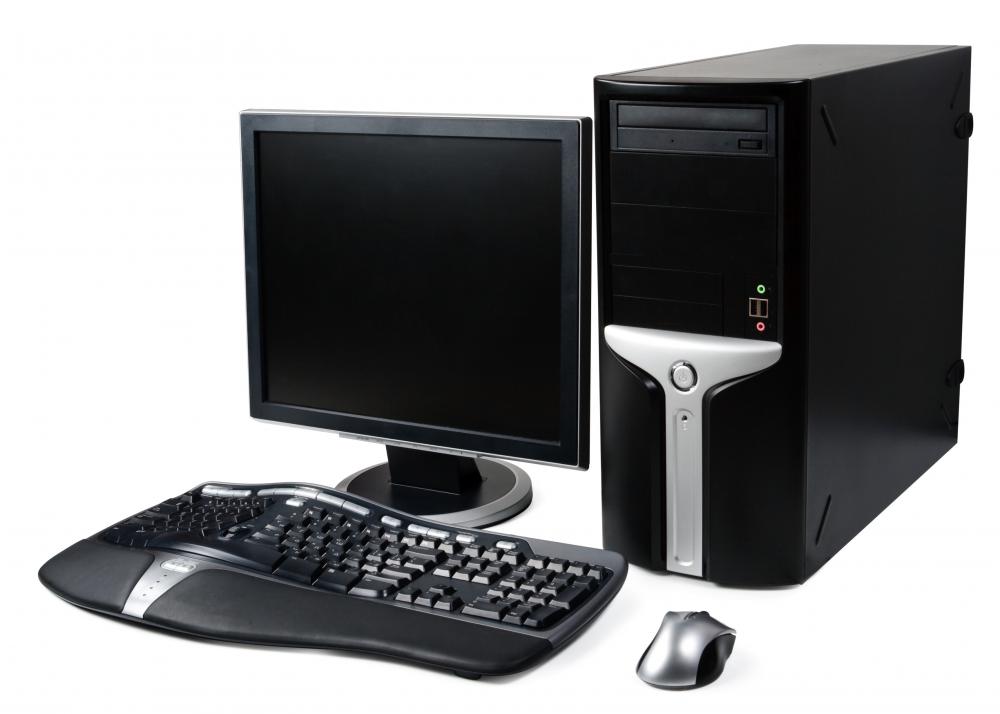
Changes: The only change I computer in my top 10 list was changing the sewage system to plumbing. I feel plumbing more accurately captures the full benefits of the invention and offers my utilities and function than just the sewage system. More info is given in the video. 1.) Computer
What is it?
•Electronic
computational device capable of difficult calculations
•Computes
arithmetic and logical operations automatically as well as reprogrammed for a
variety of functions
•Can
connect to other devices through either internet or server network
•Used
for both personal and business purposes
Prevalence: 10
Influence: 7
2.) Internet
What is it?
•Global
system of interconnected computers linking several billion devices
•Allows
for worldwide communication and data sharing instantaneously
•Database
for information, resources, and services that are publicly and freely available
to anyone
•Enables
computer, email, social media, chat, teleconferencing, and many other functions
Prevalence: 10
Influence: 8
3.)
What is it?
•Round
object developed in ancient times
•Makes
all modern travel faster, easier, and more convenient
•Paved
the way for automobiles, planes, wheelbarrows, and anything with a wheel
Prevalence: 10
Influence: 9
4.) Electricity
What is it?
•Discovered
in the 1600s by scientists William Gilbert
•Refers
to the phenomenon of the movement of electrons and charged particles to release
energy
•Rapid
expansion and implementation revolutionized society, providing functions such
as light, computation, heating, and communication
Prevalence: 10
Influence: 10
5.) Refrigeration
What is it?
•Process
of which to move heat from one place to another, usually to cool certain areas.
•Allows
for the preservation and transportation of food, expansion of settlement away
from agriculture areas
•More
effective at preservation of food, replacing smoking and salting, and allowing
for less waste of edibles
Prevalence: 7
Influence: 8
6.) Plumbing
What is it?
•Evolving
system involving the transportation, collection, treatment, and storage of liquids to households
•One
of the main factors allowing for the urbanization and condensation of society
and living space by providing water and removing waste
•Drastically
reduced environmental waste and spread of diseases, improving human lifespan
and societal cleanliness
Prevalence:9
Influence: 7
7.) Birth Control
What is it?
•Contraceptive
drastically lowering the possibly of pregnancy and transmission of sexual
diseases.
•Paved
the way for sex as a social/safe activity as well as revolutionized the way
society perceives and allows sex
•One
of the main methods to control over population
Prevalence: 4
Influence: 6
8.) Currency
What is it?
•Expression
of value in different forms of goods, whether material or electric
•Allowed
for society to move out of bartering and better leveraging and storage of
actual value goods.
•Paved
the way for electronic forms of payment and associated functions (credit cards,
checks, Apple Pay, Vemno,
bonds, stocks)
Prevalence: 9
Influence: 8
9.) Assembly Line
What is it?
•Gained
popularity during the industrial revolution
•Drastically
improved speed and quality of which products could be produced, as well as
lowering the costs
•Allowed
for the creation of more and more complex items, such as computers,
automobiles, and appliances
Prevalence: 2
Influence: 6
10) Automobile
What is it?
•Self
powered motor vehicle used for transportation or pleasure
•Owned
by majority of population, critical to the expansion of society and development
of suburban areas
•Major
increase in power available to humans for many activities, such as moving,
farming,