Beating a Patent Troll
Earlier in the semester I did a article explaining how to beat a Patent Troll. Here I want to continue the topic, although in relation to the TED video we just watched. Through this video Drew Curtis talks about his involvement in defeating a patent troll, along with a few key statistics. A few that caught my eye, was the fact it takes an average of 18 months and $2 million to beat a patent troll, assuming you even win. The average blew my mind, and suddenly it became much more clear why so many companies choose to settle instead of debating the lawsuit, regardless if they have infringed.
Another fact that stood out to me is that most startups choose to settle, regardless of whether they have infringed or not. While Mr. Curtis did not specify why they choose to settle, personally I believe it would be from one of two reasons. First and most likely, is the startup is simply too poor to refute the lawsuit in court, and the settlement represents a much cheaper and safer option out. Secondly I think many new companies might have the means of which to fight the lawsuit, but simply be intimidated by the patent troll or misinformed about the exact nature of the infringement.
In the end, regardless of the reason, this highlights a rather disturbing way of which we treat targets of patent trolls. By allowing this exploitive business model to continue, we are forcing our most innovative companies to expend precious resources and time on combating NPE's to defend their well earned inventions, eventually reducing incentives to innovate for future parties.
Sunday, April 19, 2015

The Era of Open Innovation
Cumulative Invention: Good or Bad
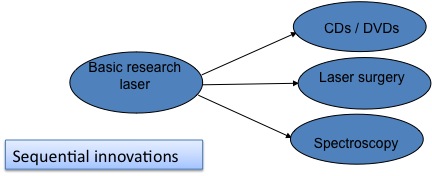
Of all the TED videos we watched during Monday's class, I related to Charles Leadbeater's the most. His stance and perspective on cumulative innovation resonated strongly with another class I am currently taking; Economics of Innovation. Like Leadbeater's video, the class stresses how the majority of innovations in today's world are not singular advancements. Instead they are continual advancements off of previous inventors before them. From what I have learned in the class, this new form of cumulative invention is very difficult to maintain incentive for. Although the first invention is critical to the second, it is difficult to reward both the first and second inventor equally for their contribution, as the 2nd inventor normally retains most of the credit. Usually such problem is remedied through running royalties or forward grants, but they are often very difficult to implement.
The video does accurately describe the problem, much more efficiently than my class I might add. It also calls into a question on how to address the problem in the future. Back paying royalties are still a very viable for of incentive for the initial inventor, as they will be receiving some funds. However they do run the risks that their invention must be useful too some future advancement that will create some economic value. The major downside I see of this system, is that most inventors who are exploring into a new industry will have to be more selective with their research, and acknowledge there is a slight chance of no return on their investment. Overall I don't believe our system has a large of a problem as portrayed in the video, but there is still a problem that needs to be addressed.

Of all the TED videos we watched during Monday's class, I related to Charles Leadbeater's the most. His stance and perspective on cumulative innovation resonated strongly with another class I am currently taking; Economics of Innovation. Like Leadbeater's video, the class stresses how the majority of innovations in today's world are not singular advancements. Instead they are continual advancements off of previous inventors before them. From what I have learned in the class, this new form of cumulative invention is very difficult to maintain incentive for. Although the first invention is critical to the second, it is difficult to reward both the first and second inventor equally for their contribution, as the 2nd inventor normally retains most of the credit. Usually such problem is remedied through running royalties or forward grants, but they are often very difficult to implement.
The video does accurately describe the problem, much more efficiently than my class I might add. It also calls into a question on how to address the problem in the future. Back paying royalties are still a very viable for of incentive for the initial inventor, as they will be receiving some funds. However they do run the risks that their invention must be useful too some future advancement that will create some economic value. The major downside I see of this system, is that most inventors who are exploring into a new industry will have to be more selective with their research, and acknowledge there is a slight chance of no return on their investment. Overall I don't believe our system has a large of a problem as portrayed in the video, but there is still a problem that needs to be addressed.
Saturday, April 18, 2015
Pool Medical Patents to Save Lives
The Dilemma of Patent Pools
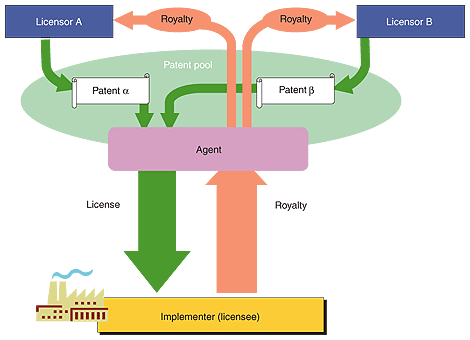
The first ever example of patent pools took place in 1903, when the Wright Brother's developed the very first flying machine. Ecstatic with there success, they immediately patented the invention and persecuted any party that infringed on their turf. There were other parties who maintained interest in the craft of flight however, and the US government eventually interviewed and forced the patent holders to share there patents with the rest of the industry, eventually kicking off the aviation industry that we know today. Without such action by the part of the government, we can never know what might have come of the airplane without the thousands of minds working on it in unions. The flight patent pool is one of most basic textbook examples of patent pools in history.
However there now exists another such example in recent years, one not as beneficial to social welfare. While many people criticized the patent pools regarding airplane manufacturing, there is a undeniable truth of the benefits it provided to society, despite the lost profits to the Wright brothers. Until recently, antiviral drugs used to treat diseases such as HIV cost nearly $12K per person per year, meaning only the most elite and wealthy could afford them. however less developed countries like India did no recognize such patents, and as such began producing their own cheap knockoffs. Eventually the cost fell to almost $350 per person, making the drug available to a much larger population. However in 1995 the Wold Trade Organization instilled a 20 year minimum patent recognition for new medication upon all countries, skyrocketing both the number of patents and cost of drugs.
Personally, I am not sure I am well versed enough in the field to make a judgment call on whether patent pools are good or bad. While the use of patent pools do help expand a industry and speed up the advancement of technological inventions, they do result in a loss of incentives and rewards for the inventor.
However there now exists another such example in recent years, one not as beneficial to social welfare. While many people criticized the patent pools regarding airplane manufacturing, there is a undeniable truth of the benefits it provided to society, despite the lost profits to the Wright brothers. Until recently, antiviral drugs used to treat diseases such as HIV cost nearly $12K per person per year, meaning only the most elite and wealthy could afford them. however less developed countries like India did no recognize such patents, and as such began producing their own cheap knockoffs. Eventually the cost fell to almost $350 per person, making the drug available to a much larger population. However in 1995 the Wold Trade Organization instilled a 20 year minimum patent recognition for new medication upon all countries, skyrocketing both the number of patents and cost of drugs.
Personally, I am not sure I am well versed enough in the field to make a judgment call on whether patent pools are good or bad. While the use of patent pools do help expand a industry and speed up the advancement of technological inventions, they do result in a loss of incentives and rewards for the inventor.
Friday, April 17, 2015
Silly Patents 1-4
*For the organizations sake, I have compiled all 4 silly patent videos and blog posts into one video and post. The majority of this post is focused on the obviousness and economic value related to this patents.
Beerbrella
Published in 2003 the Beerbrella is a removable attachment to a beverage container in order to shade the beverage from the direct rays of the sun. The apparatus comprises of a small umbrella, 5-7 inches in diameter but variable sizes are allowed. Advertisements and logos may be applied to the umbrella surface for promotional purposes. The umbrella is then to be attached to the beverage container by any means necessary, whether clip, strap, phone, insulator, coaster, or tape. The shaft of the umbrella may also be equipped with a joint to allow the umbrella to be pivoted away from the drinker.

Gerbil Shirt

Gas Factory
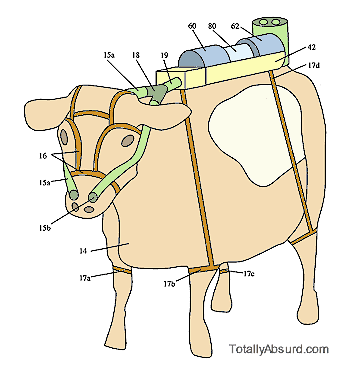
Twenty percent of all methane gas emissions come from domesticated animals, most notable farm animals. However methane is also a very potent energy source, powering gas stoves and heaters in numerous households. One creative inventor saw profit where others saw only smoke, and developed a gas factory invention; a device to be strapped to methane producing animals. The device would then capture the released methane and convert it into biomass, which could then be used as feed or cosmetics. If you notice in the diagram, the device is actually attached to the cows nostrils, instead of rear end. 95% of methane emissions actually come from exhalation instead of inhalation, which is why the majority of the device is focused on the animals front end.

Lightbulb Changer

Beerbrella
Published in 2003 the Beerbrella is a removable attachment to a beverage container in order to shade the beverage from the direct rays of the sun. The apparatus comprises of a small umbrella, 5-7 inches in diameter but variable sizes are allowed. Advertisements and logos may be applied to the umbrella surface for promotional purposes. The umbrella is then to be attached to the beverage container by any means necessary, whether clip, strap, phone, insulator, coaster, or tape. The shaft of the umbrella may also be equipped with a joint to allow the umbrella to be pivoted away from the drinker.

Gerbil Shirt
Approved in 1999, this invention is "a pet display vest for a person, having an elongated, enclosed, pet receiving, passageway extending there across with at least one closable pet admitting entry, at least part of the passageway being transparent so that, when the vest is worn, a pet moving along the passageway across a wearer's body can be viewed by a spectator."

Gas Factory
Twenty percent of all methane gas emissions come from domesticated animals, most notable farm animals. However methane is also a very potent energy source, powering gas stoves and heaters in numerous households. One creative inventor saw profit where others saw only smoke, and developed a gas factory invention; a device to be strapped to methane producing animals. The device would then capture the released methane and convert it into biomass, which could then be used as feed or cosmetics. If you notice in the diagram, the device is actually attached to the cows nostrils, instead of rear end. 95% of methane emissions actually come from exhalation instead of inhalation, which is why the majority of the device is focused on the animals front end.
Lightbulb Changer
The light bulb changer is a method and apparatus that contains components to allow for the detection and removal of a burned out light bulb, as well as automatically replacing said light with a replacement bulb. The operation requires no human invention, and can be assembled with minimal extravagant hardware requirements. The kit can allow a consumer to assemble the changer for use as a novelty item, and/or also to be used as a working light fixture, such as a table lamp, and the like. The changer can also be used as a retrofit for existing light fixtures so that the existing light fixtures can be modified.

Subscribe to:
Posts (Atom)